Candidates solve an incomplete case with an AI agent playing a workplace role. Your team receives a report on their questions and decisions, with evidence to prepare the interview.
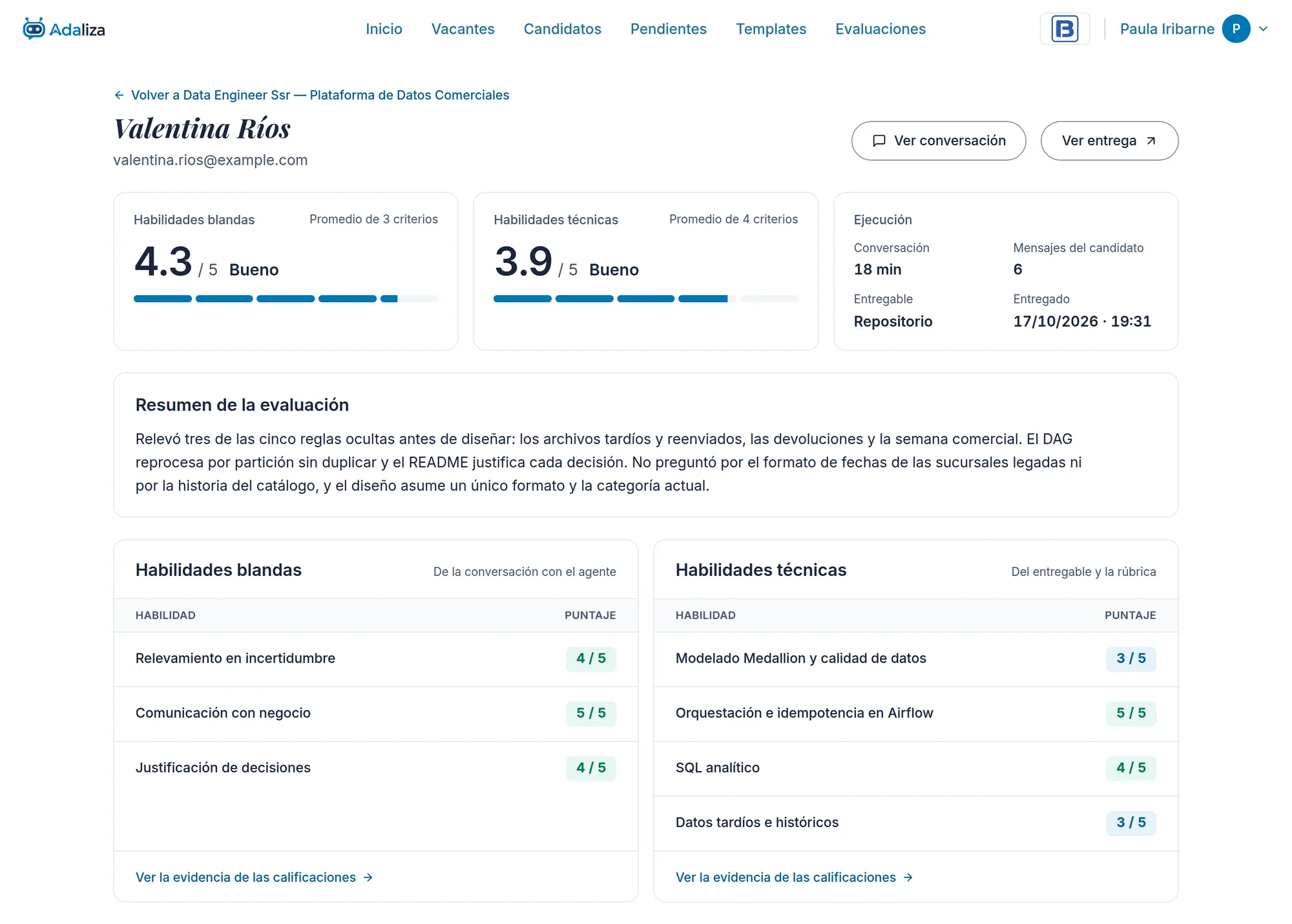
A real Adaliza screen (Spanish interface), with example data.
For tech leads and technical recruiting teams.
What is at stake
Your next hire needs room in your tech lead’s calendar.
A good deliverable leaves questions about how it was produced. Answering them candidate by candidate moves the evaluation work back into the interview.
01
The take-home shows the deliverable
With AI tools available, a correct solution alone says little about the candidate’s questions, assumptions and decisions.
02
The interview tries to recover the process
Your team spends another hour discovering how each person reasons. The search depends on finding space in the calendar again.
03
The evidence can arrive earlier
Adaliza records the conversation and deliverable. You enter the interview with an evaluated case and specific questions to explore.
What your team receives
A score you can read, discuss and support.
Each criterion connects a candidate’s decision to the evidence behind it. Go into the interview with specific questions about their work.
Your team defines the rubric. Your team makes the hiring decision.
They can use AI. We evaluate their questions, decisions and deliverable against the agreed rubric. Evidence comes from the Adaliza conversation and submission; we do not observe their external tools.
What is the candidate experience like?
They follow an individual link, with no account or installation. They see the time available and submission conditions, and know they are talking to AI and being evaluated.
What does my tech lead configure?
The scenario, agent role, conditions for revealing information and rubric. An assistant proposes a draft that your team reviews and approves.
What does my team receive?
A report with criterion-level scores and evidence from the conversation and deliverable. Your team reviews it, adds observations and decides who moves forward.
Which profiles is it suitable for?
It is designed for technical roles. Your tech lead adapts the case, agent role and criteria to the vacancy.
Does it integrate with our ATS?
It currently works independently in the browser. Your team invites through a link and reads the results in Adaliza; there is no ATS integration.
What information is kept, and who can see it?
Name and email identify the candidate; the conversation, deliverable and evaluation form the evidence. Records are kept for at least six months, with controlled access for your organisation’s authorised team.
Explore the case behind this reportFrom the brief to the evaluation: a complete Data Engineering example.
Illustrative case, built for this page. It is the same one the real platform screens show.
01 · The brief
A work scenario, incomplete on purpose.
Farmacias del Sur · Data Engineer, mid-level · 90 minutes
Design and build an Airflow DAG that ingests the daily sales CSVs of 140 branches and the product catalog, and processes them through Bronze, Silver and Gold on PostgreSQL, with data quality checks and a weekly sales and margin report. It must be re-runnable without duplicating data.
140 branches
3 million rows a day
Python · SQL · Airflow · PostgreSQL
What the brief does not say
that some files arrive late or are re-sent
how returns arrive
that the week runs Wednesday to Tuesday
that 12 branches send another date format
that products change category
02 · The conversation
The missing information is with the agent.
Candidate
Do files always arrive on time? Can a branch send one late, or re-send it corrected?
Mariana · Commercial Analytics, AI agent
Quite often. Some files arrive up to 72 hours late, and corrected ones are re-sent under the same name.
Candidate
How do returns arrive in the file?
Mariana · Commercial Analytics, AI agent
As rows with a negative quantity and the same ticket_id. Summed as they are, they inflate sales.
Candidate
When you say weekly report, does the week run Monday to Sunday?
Mariana · Commercial Analytics, AI agent
No. For us it runs Wednesday to Tuesday: that is when promotion cycles close.
Uncovered three of five hidden rules
03 · The assumptions
What she never asked is recorded too.
She never asked whether every branch sends the same format, nor whether the catalog changes. The DAG parses one date format and uses the current category, not the one on the sale date.
Unchecked assumption: date formatUnchecked assumption: catalog history
04 · The deliverable
A repository, like real work.
She submits a link to her repository: the DAG, the models per layer, the checks and a README with her decisions. Before confirming, it is checked to be accessible.
sales-medallion/
├── dags/sales_medallion.py
├── include/sql/bronze/
├── include/sql/silver/
├── include/sql/gold/weekly_report.sql
├── quality/checks_silver.py
├── tests/test_rerun.py
└── README.md
05 · The evidence
Every score, with the quote behind it.
The evaluation goes through the conversation and the deliverable against the rubric. Soft and technical skills are reported separately.
Soft skills
4.3 / 5
Gathering under uncertainty 50%
4/ 5Good
“Can a branch send a file late, or re-send it corrected?”
Communicating with the business 30%
5/ 5Outstanding
“Let me confirm: idempotent re-runs, net returns and a Wednesday-to-Tuesday week.”
Justifying decisions 20%
4/ 5Good
Partitions by file date to re-run without duplicating, and explains it in the README.
Technical skills
3.9 / 5
Medallion modelling and quality 30%
3/ 5Acceptable
Silver checks nulls, types and duplicates, but parses a single date format.
Orchestration and idempotency 30%
5/ 5Outstanding
Each task replaces its partition: running the DAG twice gives the same result.
Analytical SQL 25%
4/ 5Good
Gold aggregates net sales and margin by branch, category and commercial week.
Late and historical data 15%
3/ 5Acceptable
Picks up late files, but uses the product’s current category.
This is how your team reads it in Adaliza.
A real Adaliza screen (Spanish interface), with example data.
06 · Comparable
Everyone takes the same challenge, on the same version.
When you invite, the configuration is frozen. You compare candidates on the same rubric, not on impressions.